

Get a Quote Call our team on 07812 344364
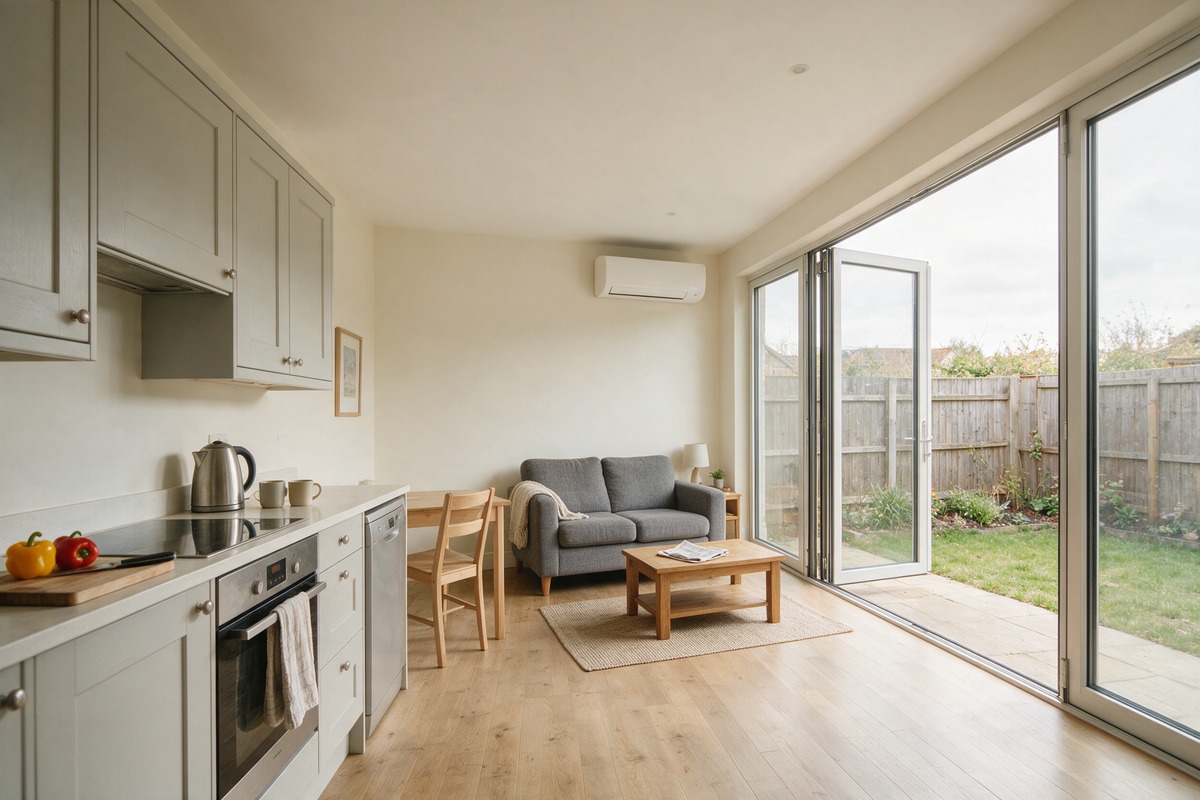
A kitchen and living room in everyday use

Why bother

What it actually does

Air conditioning has a reputation for being a summer luxury. In a British house it is mostly neither of those things. Here is what a system does in an ordinary home, in plain terms, and further down, the things it will not do.

Warm in winter, not just cool in summer

Most people hear “air conditioning” and picture a hot fortnight in July. That is half of what the machine does, and for a house in the Dales it is the less useful half.

These systems are reverse cycle, which means the same unit runs both ways. In summer it takes heat out of the room and puts it outside. In winter it does exactly the same thing backwards, taking warmth out of the outside air — there is still warmth in it at two degrees — and moving it into the room.

Practically, that means the room warms up quickly, because the unit is blowing warm air straight into it rather than heating a radiator and waiting for the room to catch up. And it is one appliance for both jobs, so nothing gets put in the loft for six months of the year.

The rooms the heating never reached

Nearly every house has one. The conservatory with a single radiator that has never once made it comfortable. The loft room at the far end of the pipework. The garden room with an oil-filled heater in the corner because there was no sensible way to run pipes to it.

Those rooms are usually not a boiler problem. They are at the end of a system that was designed around the rest of the house, and adding to that system means lifting floors and running pipe through rooms that were perfectly warm already.

An air conditioning system does not join the heating at all. It is an indoor unit, an outdoor unit and a hole between them about the width of your thumb. The rest of the house stays as it is.

Cheaper to run than a plug-in heater

A fan heater or an oil-filled radiator turns electricity into heat, one unit in for one unit out. There is no way for it to do better than that.

A heat pump is not making heat. It is picking up warmth that is already in the air outside and carrying it indoors, and the electricity only drives the pump. So it puts more heat into the room than the electricity it uses — which is the whole reason it is worth fitting rather than plugging something in.

How much more depends on the system, the room and how cold it is outside. You will find websites quoting a single figure for that. Anyone who gives you a number before they have seen the room is guessing, and we would rather tell you that than join in.

Drier air, and less water on the glass

Warm air holds moisture and cold surfaces take it back out again. That is why the conservatory glass runs with water on a January morning, and why the coldest bedroom in the house is the one with damp patches in the corners.

When one of these systems is cooling, it takes moisture out of the air as a side effect — that is what the small drain pipe running outside is for. And when it is heating, it stops the room sitting cold in the first place, which is the other half of the problem.

Being straight about it: this is not a damp course. If water is getting in through a wall or a roof, air conditioning will not stop it and you need somebody else. What it deals with is a room that is cold and stuffy and wet on the inside of the windows.

The room air goes through a filter

An indoor unit works by pulling room air in, doing something to it and blowing it back out. On the way in it passes through a filter, so every time the system runs it is also taking dust and pollen out of the air in that room.

It matters most in the weeks when you would otherwise have the windows open — a still night in June, or whenever the fields around are being cut. You can keep the windows shut and the room still does not go stuffy.

What we will not do is tell you what that means for anyone’s health, because that is not our trade. What we can tell you is what the filter is, that it washes out under a tap, and that cleaning it is part of a service.

Quiet, and out of the way

The part people picture — the boxy thing that roars — is the outdoor unit, and it lives outside. What goes in the room is slim, white, mounted high on the wall, and mostly does not get looked at after the first week.

Indoors it is a fan moving air. On a low setting in a bedroom it is the sort of noise you stop hearing, which is the point: the room is comfortable enough to sleep in with the window shut.

Where the outdoor unit goes is worth thinking about properly, and it is one of the things we look at during the survey — how far it is from a bedroom window, yours or next door’s, and how the pipe run gets to it.

The other side of it

What it will not do

Worth knowing before you spend anything, and easier to say now than at the survey.

  • Heat the whole house from one unit

    One indoor unit deals with one room, or one open-plan space. It will not push warmth round a corner and up a staircase. A house-wide system is a different job, a bigger one, and usually not what anybody actually wants.

  • Fix damp coming in from outside

    It takes moisture out of the air in the room. It does nothing about a leaking gutter, a failed damp course or water tracking through a wall. If that is what is happening, you want a builder before you want us.

  • Go in without an outdoor unit

    There has to be a box on an outside wall or on the ground, and a pipe run to reach it. On most houses that is straightforward. On some — a flat with no outside wall of its own, or a listed frontage — it is the thing that decides whether the job can happen at all.

Which room did you have in mind?

The survey is free and the quote is itemised. If the answer is that air conditioning is the wrong thing for your room, we will tell you that instead.

We fit

  • Mitsubishi
  • Daikin
  • Samsung
  • Panasonic
  • Toshiba
  • Bosch
  • Fujitsu
  • Midea
  • LG
  • electriQ

Which system suits you depends on the room, the layout and the budget. That is a conversation to have at the survey, standing in the room, rather than a decision to make off a website.